Picture this. You're at the local playground. Your eight-year-old son grips the monkey bars. He swings once. His arms shake. He drops to the mulch, frustrated, while his friends effortlessly glide across. You brush off his disappointment, but a quiet worry creeps in. Is he just out of shape? Or is something missing in his diet?
Fast forward to the annual pediatrician visit. The doctor checks his height and weight. She notes he's lagging in muscle mass and bone density compared to his peers. She doesn't prescribe medicine. She hands you a pamphlet on nutrition. The missing link isn't just calories. It's high-quality protein.
Kids grow in rapid spurts. Their bodies demand massive amounts of raw materials to build new tissue. Without the right building blocks, growth stalls. Muscle stays weak. Bones stay fragile. High-quality protein is the ultimate growth hack for your child. Here is how you can easily add it to their daily meals.
The Root of the Issue: Why Protein is the Master Builder
Many parents think calcium is the only thing kids need for strong bones. That's a myth. Bones aren't just chalky mineral deposits. They are living, dynamic tissues. About half of bone volume is actually a protein matrix, mostly collagen [NIH]. This collagen framework gives bones their flexibility and tensile strength. Calcium just hardens the frame. Without enough protein, that frame stays brittle and prone to injury.
Muscle development works on a similar principle. Kids aren't just growing taller. They are building the physical machinery to move, jump, and play. Muscle tissue is roughly 80% protein [USDA]. When your child runs, climbs, or lifts, they create microscopic tears in their muscle fibers. Protein repairs these tears, making the muscle thicker and stronger.
But not all protein is created equal. This is where "high-quality" comes into play.
Complete vs. Incomplete Proteins
Your body breaks down dietary protein into amino acids. There are 20 different amino acids. Nine of them are essential. The body can't make them. You must get them from food [Harvard Public Health].
High-quality proteins are "complete." They contain all nine essential amino acids in the right ratios. Animal sources like meat, dairy, and eggs are complete proteins. They trigger muscle protein synthesis much more effectively than plant-based alternatives [AND].
Low-quality proteins are "incomplete." They lack one or more essential amino acids. Beans, nuts, and grains fall into this category. Kids can still eat them. You just need to combine them properly, like pairing rice with beans, to get a complete amino acid profile. Relying solely on incomplete proteins without careful planning often leads to suboptimal muscle and bone development.
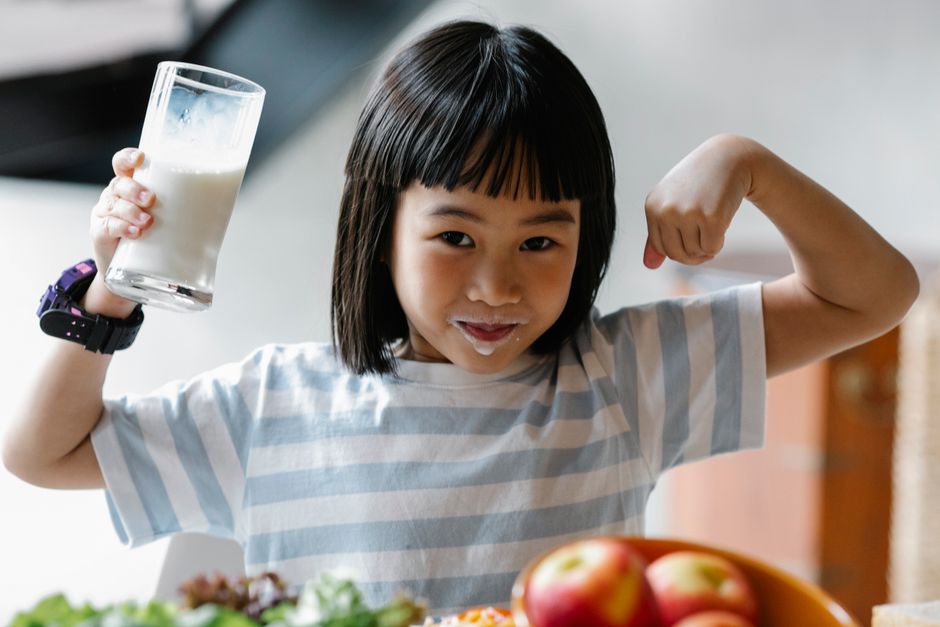
A Practical Guide to Feeding for Growth
Knowing the science is one thing. Getting a picky eater to actually consume it is another. You don't need to overcomplicate mealtime. You just need a solid strategy.
How Much Protein Does Your Child Actually Need?
The requirements change as kids grow. Toddlers need less. Teenagers need a lot. The Recommended Dietary Allowance (RDA) for children aged 4 to 8 is about 19 grams per day [NIH]. Kids aged 9 to 13 need around 34 grams. Teen boys might need up to 52 grams, while teen girls need about 46 grams [USDA].
Don't just stare at those numbers. Think in terms of meals. A single chicken breast has about 30 grams of protein. A cup of Greek yogurt packs 20 grams. Hitting the daily target is easier than you think.
The Best High-Quality Protein Sources
Build your grocery list around these powerhouse foods.
*Eggs:* The gold standard. One large egg gives you 6 grams of high-quality protein. The yolk contains crucial nutrients for bone health, too [Cleveland Clinic].
*Dairy:* Milk, cheese, and yogurt are fantastic. Greek yogurt is especially dense. A half-cup serving can deliver up to 10 grams of protein. Dairy also provides the calcium and vitamin D needed to mineralize that protein bone matrix [Mayo Clinic].
*Lean Meats:* Chicken, turkey, and lean beef are excellent. They also supply iron and zinc, minerals critical for cellular growth and immune function [WHO].
*Fish:* Salmon and tuna are great choices. Fatty fish adds omega-3 fatty acids to the mix. Omega-3s reduce inflammation and support joint health, keeping active kids moving pain-free [AHA].
Sneaking Protein into Picky Eaters' Diets
Kids can be stubborn. If they see a piece of fish, they might turn their nose up. Get creative.
Blend silken tofu or Greek yogurt into fruit smoothies. They won't taste the difference, but they'll drink down 15 grams of protein in seconds.
Swap out regular pasta for lentil or chickpea pasta. It looks and tastes similar but doubles the protein content.
Make homemade meatballs or turkey burgers. Hide finely grated zucchini or carrots inside the mix.
Keep hard-boiled eggs, cheese sticks, and edamame in the fridge for quick snacks. Snacking is a massive opportunity to boost daily intake without turning it into a battle at the dinner table.
Timing and Synergy: Maximizing the Benefits
Eating protein isn't just about hitting a daily number. How and when your child eats it matters, too.
Spread It Out

The body doesn't store protein for later use like it does with fat or carbs. It uses what it needs immediately and excretes the rest. Dumping 40 grams of protein into one massive dinner won't optimize muscle growth.
Spread the intake across the day. Aim for 10 to 15 grams at breakfast, lunch, and dinner. Include a protein-rich snack in the afternoon. This steady stream of amino acids keeps muscle protein synthesis elevated throughout the day [LPI].
Don't Forget the Co-Factors
Protein doesn't work in a vacuum. It needs helpers to build bone and muscle effectively.
Vitamin D is non-negotiable. It helps the gut absorb calcium, which hardens the protein bone matrix. Without it, bones stay soft regardless of how much protein your child eats [CDC]. Get them outside for some sunlight, or talk to your pediatrician about a supplement.
Vitamin C is equally crucial. The body needs it to synthesize collagen. Collagen is the main structural protein in bones and muscles. Oranges, strawberries, and bell peppers are great sources to pair with their protein-rich meals [Johns Hopkins].
Magnesium and potassium also play vital roles in muscle contraction and bone density. Leafy greens, bananas, and nuts cover these bases easily.
Summary
Childhood is a fleeting window of rapid physical development. You can't pause it. You can only fuel it. High-quality protein is the fundamental building block for strong muscles and resilient bones. It provides the essential amino acids your child's body desperately craves to grow.
Focus on complete proteins. Spread them evenly across the day. Pair them with vital vitamins and minerals. You don't need expensive supplements or complicated diets. Just real, nutrient-dense foods.
Next time you're at the playground, watch your child tackle those monkey bars. With the right nutritional foundation, they won't just keep up. They'll fly past the rest.
References
This article references the following authoritative sources:
- World Health Organization — United Nations agency responsible for international public health
- Centers for Disease Control and Prevention — US national public health agency
- National Institutes of Health — US government medical research agency
- Mayo Clinic — Nonprofit American academic medical center
- Cleveland Clinic — American nonprofit academic medical center
- Johns Hopkins Medicine — American academic medical center and health system
- Harvard T.H. Chan School of Public Health — Harvard University public health graduate school
- Academy of Nutrition and Dietetics — World's largest organization of food and nutrition professionals
- USDA FoodData Central — US Department of Agriculture food composition database
- American Heart Association — Nonprofit focused on heart disease and stroke prevention
- Linus Pauling Institute — Micronutrient research institute at Oregon State University