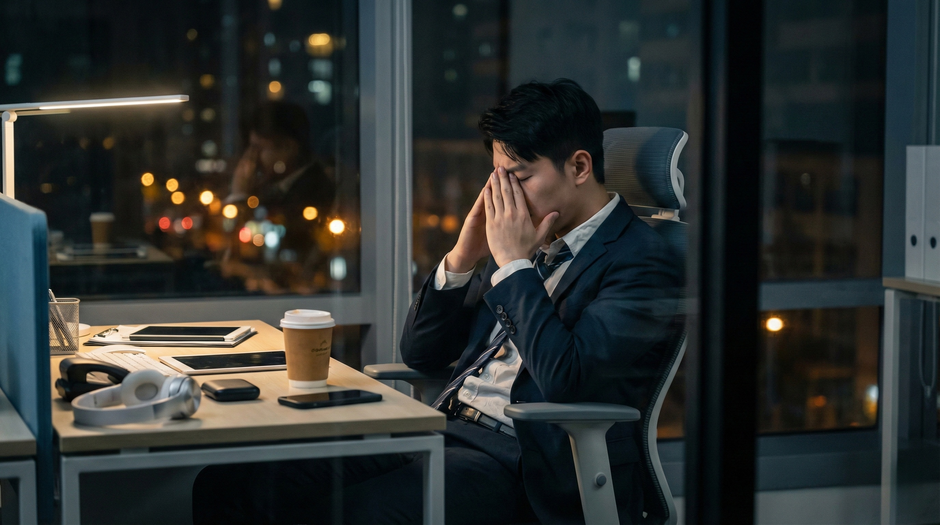
It's 7 a.m. and your alarm sounds like it's coming from inside a cave. You finally fell asleep at 3 — maybe it was a deadline, a crying baby, a flight delay, or just one more episode that turned into five. Now your eyes burn, your brain feels wrapped in wet towels, and you've got a full day ahead that doesn't care how little sleep you got.
You stumble to the kitchen and reach for the biggest mug you own. Hold that thought. The next 16 hours can go two ways: you can zombie-shuffle through them and wreck tonight's sleep too, or you can follow a deliberate reset plan that gets you functional by mid-morning and back to normal by tomorrow. Here's exactly what staying up late did to your body — and the step-by-step fix.
What One Bad Night Actually Does to You
Recovery works better when you know what you're fighting. Three things went wrong last night, and each one needs a different countermeasure.
First, there's adenosine. This chemical builds up in your brain the longer you're awake, creating "sleep pressure" — that heavy, can't-keep-your-eyes-open feeling [NIH]. Deep sleep normally flushes it out. Shortchange your sleep, and you wake up with residual adenosine still clogging the system. That's your brain fog, right there.
Second, your circadian rhythm got scrambled. Your internal clock runs on light, hormones, and timing cues, and it expected sleep at a certain hour. When you stayed up, you pushed cortisol, melatonin, and body temperature rhythms out of sync — which is why you can feel wired at 2 a.m. and destroyed at 2 p.m.
Third, your brain took a real performance hit. Sleep loss impairs attention, working memory, and reaction time. The CDC notes that being awake for 17 hours straight produces impairment similar to a blood alcohol concentration of 0.05% [CDC]. You wouldn't do your job tipsy. Last night, you essentially set yourself up to.
The good news: a single rough night is very recoverable. Your body wants to bounce back. You just have to stop fighting it.
Your Step-by-Step Recovery Plan
Step 1: Get Bright Light Within 30 Minutes of Waking
Light is the strongest lever you have for resetting your circadian clock. Get outside for 10 to 15 minutes as soon as you can after waking — no sunglasses, even if it's overcast. Outdoor light, even on a gray day, is many times brighter than anything in your house.
This does two things: it suppresses lingering melatonin so you feel more alert now, and it anchors your body clock so you'll actually feel sleepy at a reasonable hour tonight. Skip this, and you're fighting your biology all day.
Step 2: Hydrate Before You Caffeinate
You lost water overnight through breathing and sweat, and even mild dehydration worsens fatigue and concentration. Drink a large glass of water before your first coffee. Then keep sipping through the morning.
Yes, you'll still have the coffee. Just don't let it be the first thing your dehydrated, stressed-out body receives.

Step 3: Use Caffeine Like a Surgeon, Not a Fire Hose
Here's where most people blow it. They mainline espresso all day, feel jittery instead of alert, and then can't fall asleep at night — restarting the whole cycle.
Better approach: have one or two normal cups of coffee or tea in the morning, spaced an hour or two apart. Then cut yourself off by early afternoon. Caffeine has a half-life of roughly five hours, meaning a 3 p.m. latte is still half active in your system at 8 p.m. [Sleep Foundation]. The goal today isn't to feel amazing. It's to feel decent now and sleepy tonight.
Step 4: Nap — But Only Like This
A nap is your most powerful recovery tool, and also the easiest one to misuse. The rules are simple:
- Keep it to 20–25 minutes. Long enough to restore alertness, short enough to avoid deep sleep, which would leave you groggier than before.
- Nap before 3 p.m. A late nap eats into your sleep pressure for tonight.
- Try the "coffee nap" if you're brave: drink a coffee right before lying down. Caffeine takes about 20 minutes to kick in, so you wake up just as it hits. Research on short naps shows they reliably boost alertness and performance [Sleep Foundation].
Set an alarm. Two of them. This is not the day your willpower is trustworthy.
Step 5: Eat for Stable Energy, Not a Sugar Rollercoaster
Sleep deprivation messes with hunger hormones — it pushes ghrelin (the "eat now" hormone) up and leptin (the "I'm full" signal) down, which is why you're craving donuts and fries today [NIH]. Give in, and you'll ride a spike-crash cycle that makes the fog worse.
Instead, build your meals around protein and complex carbs: eggs and whole-grain toast at breakfast, chicken or tofu with rice and vegetables at lunch. These digest slowly and keep your blood sugar — and your energy — steady. If you want something sweet, have it after a meal, not on an empty stomach.
Step 6: Move Your Body, Gently
Exercise is probably the last thing you want to do. Do a little anyway. A brisk 10- to 20-minute walk increases blood flow, bumps up oxygen delivery to your brain, and gives you a clean, caffeine-free alertness boost.
Keep it light, though. This is not the day for a punishing workout or a new deadlift PR. Sleep loss impairs coordination and reaction time, and your recovery capacity is already spent. Walk, stretch, do some easy bodyweight movement — enough to wake your system up, not enough to drain it further.
Step 7: Protect Tonight Like It's the Whole Point — Because It Is
Everything above is scaffolding. The actual repair happens tonight, during real sleep, when your brain clears metabolic waste and your body does its maintenance work [NIH].
A few rules for tonight:
- Go to bed 30 to 60 minutes earlier than usual — not three hours earlier. Crashing at 8 p.m. will likely leave you staring at the ceiling or waking at 4 a.m.
- Don't "catch up" by sleeping until noon tomorrow. A huge sleep-in shifts your body clock again and sets you up for a rough Monday. An extra hour or so is plenty.
- Keep your normal wake time tomorrow morning, and get that bright light again. Consistency is what locks your rhythm back in place.
Adults need at least seven hours of sleep per night for optimal health [AASM]. Tonight, treat that number as non-negotiable.
One Hard Warning: Don't Drive Drowsy
If you're seriously sleep-deprived, your reaction time and judgment are impaired in ways you can't feel from the inside. Drowsy driving is responsible for thousands of crashes and deaths every year [CDC]. If you're nodding off at your desk, you have no business merging onto a highway. Take transit, call a ride, or nap first.
Summary
References
This article references the following authoritative sources:
- Centers for Disease Control and Prevention — US national public health agency
- National Institutes of Health — US government medical research agency
- American Academy of Sleep Medicine — Professional society for sleep medicine
- Sleep Foundation — Independent organization providing sleep health information