It's 11:40 PM. You told yourself you'd sleep an hour ago. Instead, you're three videos deep into content you won't remember tomorrow, thumb moving on autopilot, eyes burning. You lock the screen, feel a wave of guilt, unlock it again "just to check one thing." Sound familiar?
You're not weak-willed. You're up against a system engineered to keep you hooked — and the only way to win is to stop relying on willpower altogether. This guide breaks down why bedtime scrolling is so sticky, then walks you through a practical, step-by-step plan to quit for good.
Why You Can't Stop: The Real Reasons Behind Bedtime Scrolling
Most advice fails because it treats the symptom ("put the phone down!") instead of the cause. Here's what's actually happening in your brain at midnight.
Your Brain Is Chasing Dopamine
Social feeds, short videos, and notifications run on variable rewards — the same mechanism that makes slot machines addictive. Sometimes you scroll and find nothing. Sometimes you find something hilarious, shocking, or personally relevant. That unpredictability keeps your brain pulling the lever, hoping the next swipe pays off.
At night, you're especially vulnerable. Your prefrontal cortex — the part responsible for self-control — is tired after a full day of decisions. The dopamine-driven parts of your brain face almost no resistance. So "just five minutes" becomes ninety.
Revenge Bedtime Procrastination
There's a name for what many of us do: revenge bedtime procrastination. When your day feels controlled by work, chores, and other people's demands, late-night scrolling becomes stolen "me time." You sacrifice sleep to reclaim a sense of freedom [Sleep Foundation].
This matters because quitting isn't just about the phone. If bedtime scrolling is your only daily pocket of autonomy, removing it without replacing it will feel like losing something — and you'll relapse within a week.
Blue Light and Your Body Clock
The habit also sabotages you biologically. Blue-wavelength light from screens suppresses melatonin, the hormone that signals your body it's time to sleep [Harvard Public Health]. On top of that, the content itself — arguments, news, exciting videos — keeps your mind alert when it should be powering down [AASM].
The result: you fall asleep later, sleep worse, wake up groggy, and reach for your phone again that night because you're too drained to do anything else. It's a loop. Breaking it requires attacking the loop, not just the behavior.
The Practical Guide: How to Break the Habit for Good
Here's the plan. It's built on one principle: make the bad habit hard and the good alternative easy. Willpower is optional.
Step 1: Get the Phone Out of the Bedroom
This is the single highest-impact move, and it's non-negotiable if you want to quit completely.
Charge your phone in another room — the kitchen, the hallway, anywhere that requires standing up and walking. Buy a basic alarm clock for $15 so "I need it for my alarm" stops being an excuse. Set a consistent bedtime for the phone itself: say, 9:30 PM, it goes on the charger, and your night begins.

Will you feel anxious the first few nights? Probably. That discomfort is the addiction revealing itself. It fades faster than you'd expect — most people report the urge dropping sharply within one to two weeks [Cleveland Clinic].
Step 2: Replace, Don't Just Remove
Remember revenge bedtime procrastination? You need a replacement for that "me time," or the habit will claw its way back.
Pick activities that feel genuinely enjoyable, not virtuous chores:
- A physical book or e-reader (paperwhite screens, no apps, no notifications)
- A podcast or audiobook with a sleep timer — you get entertainment without the screen
- Light stretching or a warm shower — both help your body transition toward sleep [Mayo Clinic]
- Journaling or a simple brain dump — write down tomorrow's worries so they don't follow you into bed
- Conversation with a partner, or a few minutes of doing absolutely nothing
The key is choosing something you'll actually look forward to. If your replacement feels like punishment, you'll be back on the feed by Thursday.
Step 3: Build a 30-Minute Wind-Down Routine
Sleep specialists recommend a consistent pre-sleep routine because it trains your brain to associate specific cues with sleep onset [NSF]. Keep it simple — three steps, same order, every night.
A sample routine:
1. 9:30 PM — Phone goes on its charger in the kitchen. Lights dim.
2. 9:40 PM — Warm shower, then change into sleep clothes.
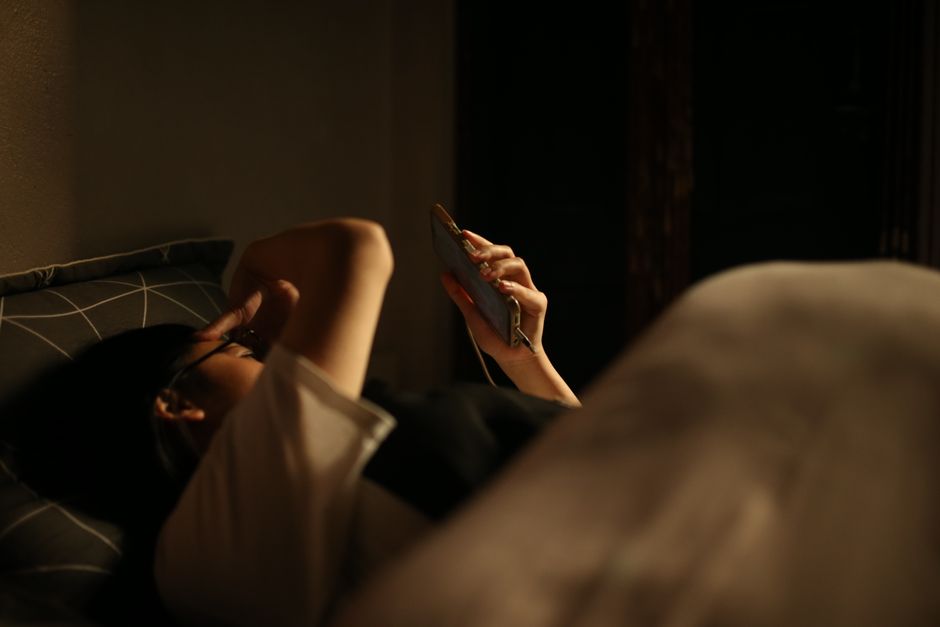
3. 10:00 PM — Twenty minutes of reading in bed, lights out by 10:30.
Consistency matters more than perfection. Your body clock thrives on regularity, and a stable sleep-wake schedule is one of the strongest predictors of good sleep quality [AASM]. Within two to three weeks, the routine itself will start making you drowsy — that's classical conditioning working in your favor for once.
Step 4: Add Friction Everywhere Else
For the transition period — or for evenings when you need your phone nearby — stack the deck with friction:
- Grayscale mode. Removing color makes feeds dramatically less stimulating. Many people find scrolling boring within minutes.
- App timers and blockers. Set hard limits on your biggest time-sinks starting at 9 PM. Use tools that require a password someone else holds, or at least a deliberate 30-second delay.
- Log out of the worst apps each morning. Having to log back in is often enough friction to break the autopilot reach.
- Turn off every non-essential notification. If it isn't a call or message from a real human, it can wait until morning.
- Charge at 20%. Some people deliberately avoid charging their phone in the evening, letting a dying battery force the issue.
None of these work alone. Together, they turn mindless scrolling into a series of small, conscious decisions — and conscious decisions are where you win.
Step 5: Handle Slips Without Spiraling
You will slip. Maybe a stressful day, maybe travel, maybe boredom. One bad night means nothing. What kills progress is the "well, I've already failed" spiral that turns one slip into a full relapse.
When it happens, skip the guilt and ask a better question: *what was the trigger?* Was the phone on your nightstand again? Did you skip your wind-down routine? Were you avoiding something stressful? Fix the trigger, not yourself.
It also helps to track the payoff. Poor sleep is linked to impaired concentration, mood
References
This article references the following authoritative sources:
- Mayo Clinic — Nonprofit American academic medical center
- Cleveland Clinic — American nonprofit academic medical center
- Harvard T.H. Chan School of Public Health — Harvard University public health graduate school
- National Sleep Foundation — Nonprofit dedicated to sleep health education
- American Academy of Sleep Medicine — Professional society for sleep medicine
- Sleep Foundation — Independent organization providing sleep health information