Introduction
When parents think about their children's health, vision problems and obesity usually top the list of concerns. Yet there is another condition quietly affecting millions of adolescents worldwide — one that often goes unnoticed until it becomes serious. Scoliosis, an abnormal sideways curvature of the spine, has now been recognized in China and beyond as the third most pressing health threat to adolescents, following myopia and obesity. The good news is that scoliosis is highly manageable when caught early. The challenge is that it rarely causes pain in its initial stages, which means many cases slip under the radar until visible deformity appears. This article explains what scoliosis is, why it poses such a significant risk to teenagers, and how early screening and timely treatment can change outcomes dramatically.
What Is Scoliosis?
Scoliosis is defined as a lateral (sideways) curvature of the spine measuring 10 degrees or more on an X-ray, measured using what doctors call the Cobb angle. Rather than running straight down the back, the spine curves into an "S" or "C" shape, sometimes accompanied by rotation of the vertebrae.
Types of Scoliosis
Scoliosis falls into several categories:
- Idiopathic scoliosis: The most common form, accounting for roughly 80% of cases. It has no clearly identifiable cause and typically appears during the growth spurt just before puberty, usually between ages 10 and 15.
- Congenital scoliosis: Present at birth, caused by abnormal vertebral development in the womb.
- Neuromuscular scoliosis: Linked to conditions such as cerebral palsy or muscular dystrophy.
Of these, adolescent idiopathic scoliosis (AIS) is by far the greatest public health concern, affecting an estimated 2–3% of teenagers globally. In China alone, some estimates suggest more than five million adolescents live with the condition, with hundreds of thousands of new cases emerging each year.
Why Scoliosis Is a Serious Threat to Adolescent Health
Calling scoliosis a "health killer" may sound dramatic, but its impact — physical, functional, and psychological — is real and far-reaching.
Physical Consequences
Mild scoliosis may cause little more than uneven shoulders or a slightly tilted posture. As the curve progresses, however, the consequences become more serious:
- Chronic back pain: Muscle imbalance and uneven loading of the spine frequently lead to persistent discomfort.
- Visible deformity: Rib humps, prominent shoulder blades, and uneven hips can develop as the spine rotates.
- Cardiopulmonary problems: In severe cases (curves exceeding 60–80 degrees), the distorted rib cage compresses the lungs and heart, reducing lung capacity and cardiovascular function.
- Reduced mobility and fatigue: An unbalanced spine forces muscles to work harder, leading to early exhaustion during physical activity.
Psychological and Social Effects
Teenagers are at a stage of life where body image matters enormously. Visible spinal deformity can trigger self-consciousness, social withdrawal, anxiety, and even depression. Studies have shown that adolescents with moderate to severe scoliosis report significantly lower self-esteem and quality of life. The condition doesn't just bend the spine — it can bend a young person's confidence at a critical moment in their development.
Why Adolescents Are Especially Vulnerable
The teenage years are a perfect storm for scoliosis progression. During rapid growth spurts, a small curve can worsen by several degrees per month. A child with a 15-degree curve at age 11 may progress to 40 degrees or more by age 14 if left unmonitored. Once skeletal maturity is reached, progression typically slows — but by then, the structural damage may be permanent.
Girls face a particularly high risk. While boys and girls develop mild scoliosis at similar rates, girls are up to eight times more likely to experience curve progression requiring treatment.
Warning Signs Parents Should Watch For
Early scoliosis is painless, which is precisely why it is so dangerous. Parents should routinely look for these signs:
- One shoulder sitting higher than the other
- One shoulder blade sticking out more prominently
- An uneven waistline or one hip appearing higher
- The head not centered over the pelvis
- Clothes that hang unevenly, such as one pant leg appearing longer
- A visible curve in the spine when the child bends forward
Any of these signs warrants a professional evaluation.
The Critical Role of Early Screening
Because scoliosis rarely announces itself through pain, screening is the only reliable way to catch it early. Fortunately, screening is simple, inexpensive, and non-invasive.
The Adam's Forward Bend Test
This is the most widely used screening method, and parents can perform a version of it at home:
1. Have the child stand with feet together and knees straight.
2. Ask them to bend forward at the waist, letting their arms hang loosely toward the floor.
3. Observe the back from behind at eye level. Look for any asymmetry — a rib hump on one side or unevenness in the back contour.
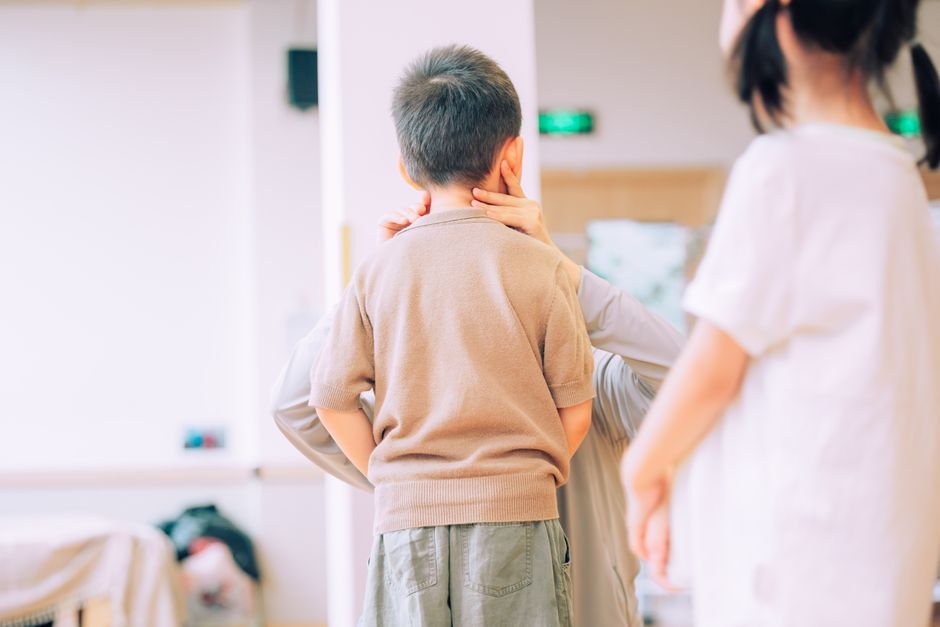
A noticeable one-sided prominence is a red flag that should prompt a medical visit.
Professional Diagnosis
If screening suggests scoliosis, a doctor will conduct a physical examination, possibly measure the trunk rotation with a scoliometer, and order a standing X-ray to calculate the Cobb angle. This measurement determines both the diagnosis and the treatment pathway. Many schools now include spinal screening in routine health checks — a practice health experts strongly encourage, since school-based programs have proven effective at catching cases before visible deformity develops.
Treatment: Why Timing Changes Everything
The earlier scoliosis is detected, the more treatment options remain available — and the less invasive they tend to be.
Observation (Curves Under 20–25 Degrees)
Mild curves in growing children are monitored with regular check-ups and periodic X-rays every four to six months. Many mild cases stabilize on their own and never require intervention. Physical therapy and posture exercises may support overall spinal health during this period.
Bracing (Curves of 25–40 Degrees in Growing Children)
For moderate curves in children who are still growing, bracing is the standard treatment. A properly fitted orthotic brace won't straighten the spine, but it can halt progression in the majority of compliant patients. Bracing works — but only while growth plates remain open, which is exactly why late detection so often leads to surgery.
Surgery (Curves Over 45–50 Degrees)
Severe curves typically require spinal fusion surgery to correct and stabilize the spine. Modern surgical techniques have improved outcomes considerably, but surgery remains a major procedure with a long recovery. The vast majority of surgeries could theoretically be avoided if curves were detected and braced early enough.
The contrast could not be clearer: a curve caught at 20 degrees is watched; caught at 30 degrees, it is braced; caught at 50 degrees, it often faces the operating room.
Prevention and Healthy Habits
While idiopathic scoliosis cannot be fully prevented, good habits support spinal health and make abnormalities easier to notice:
- Encourage regular physical activity, especially swimming, core strengthening, and stretching.
- Promote good posture when sitting at desks and using electronic devices.
- Choose ergonomic backpacks worn over both shoulders, and avoid overloading them.
- Ensure balanced nutrition with adequate calcium and vitamin D for bone development.
- Schedule routine spinal checks, especially during growth-spurt years.
Summary
Scoliosis has earned its place as the third major health threat to adolescents for good reason: it is common, silent in its early stages, and capable of causing lasting physical and psychological harm if ignored. Yet scoliosis is also one of the most manageable conditions in adolescent medicine — provided it is found in time. A simple forward bend test at home, routine school screenings, and prompt professional evaluation can mean the difference between watchful observation and major spinal surgery. Parents, educators, and healthcare providers all share responsibility for keeping adolescent spines in check. When it comes to scoliosis, the message is simple but powerful: screen early, treat early, and give every teenager the chance to stand tall.